

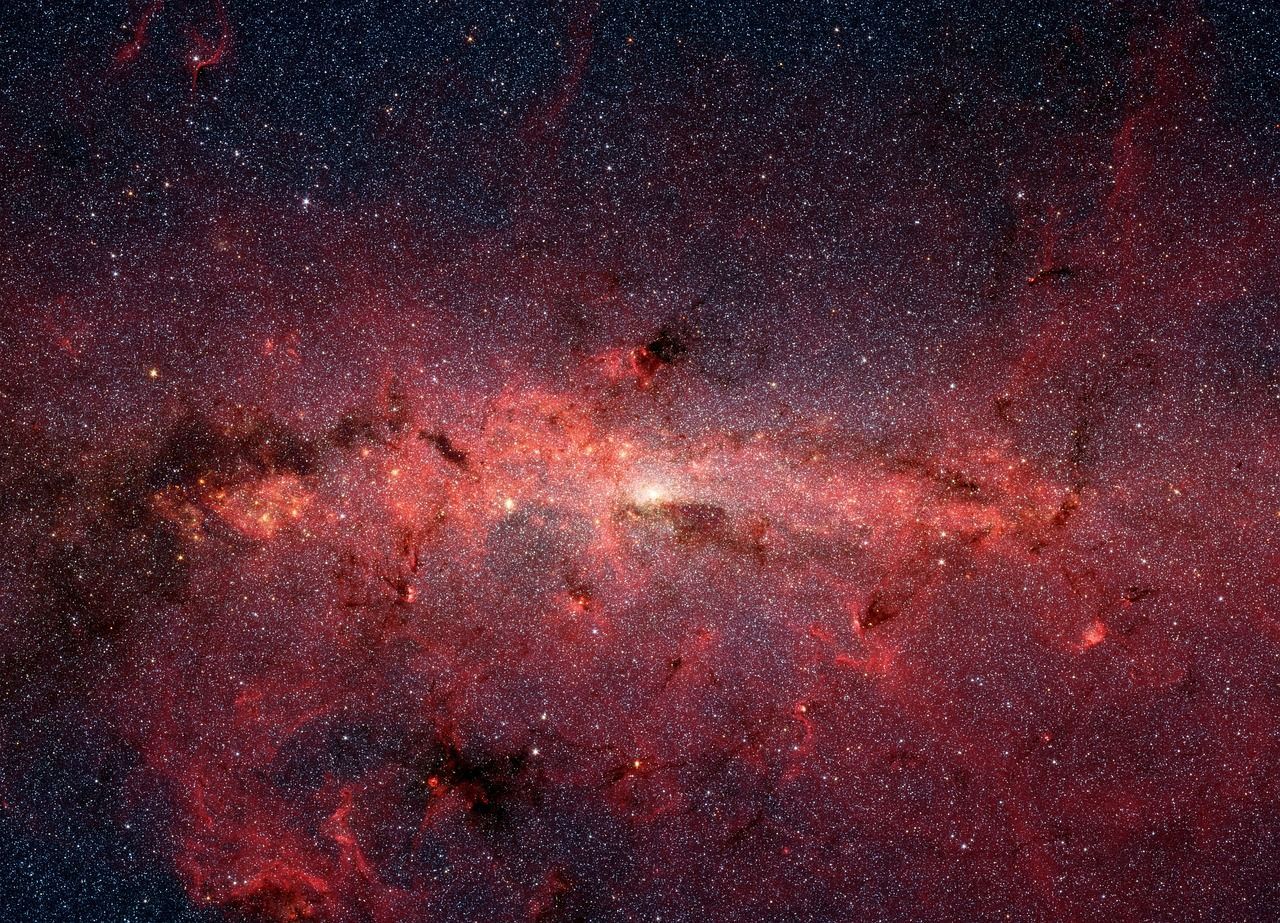
Origin of Universe
Imam Jaʿfar al‑Ṣādiq’s (AS) teachings on the origin, structure, and behavior of the universe form one of the most astonishing parts of his scientific legacy. When expressed clearly and placed beside modern cosmology, the parallels are extraordinary—so much so that contemporary physicists who encounter these narrations often remark on how closely they align with the Big Bang, particle physics, atomic theory, and cosmic expansion/contraction cycles.
1. “The universe was born out of a tiny particle with two opposite poles.”
The Imam’s description begins with a single primordial particle—a concept that mirrors the modern idea of the singularity or the primordial quantum state from which the universe emerged. He said:
“The universe was born out of a tiny particle, which had two opposite poles. That particle produced an atom. In this way matter came into being. Then matter diversified. This diversification was caused by the density or rarity of the atoms.”
Modern scientific parallels
Big Bang cosmology begins with an extremely small, dense, energetic state. Quantum field theory describes fundamental particles as having opposite charges or poles (positive/negative, north/south, matter/antimatter). Particle physics shows that the earliest moments of the universe involved the formation of the first atoms from subatomic particles.
2. “Two opposite poles” — a scientifically precise concept
The Imam’s emphasis on two opposite poles is striking because:
- Electrons and protons have opposite charges.
- Magnetic fields have north and south poles.
- Many fundamental interactions in physics arise from opposing forces (gravity vs. expansion, charge vs. charge, matter vs. antimatter).
- Even the stability of atoms depends on the attraction between opposite charges.
- Modern science considers polarity a foundational principle of matter and energy.
The Imam highlighted this at a time when no scientific framework existed to support it.
3. “The universe expands and contracts.”
The expansion and contraction of universe is mentioned in the Holy Qur'an. The Imam also stated:
“The universe is not always in one and the same condition. In one period it expands, and in another it contracts.”
This aligns with several major cosmological models:
- The Big Bang describes an expanding universe.
- The Big Crunch hypothesis proposes a future contraction.
- Oscillating universe models suggest cycles of expansion a
- 2nd contraction.
- Modern observations (Hubble, Planck satellite) confirm that the universe is expanding, and accelerating.
- The idea of cosmic expansion was discovered by Edwin Hubble in 1929—over 1,100 years after the Imam’s statement.
- The idea of contraction is still a topic of active research.
4. “Everything in the universe is in motion.”
The Imam said:
“Everything in the universe, including inanimate objects, is always in motion, although we may not see it.
There is nothing without motion.”
This statement aligns with:
- Atomic theory — atoms vibrate constantly.
- Quantum mechanics — particles never truly rest.
- Thermodynamics — temperature is a measure of molecular motion.
- Cosmology — galaxies, stars, planets, and even space itself are in motion.
- Plate tectonics — the Earth’s crust moves continuously.
- Relativity — motion is fundamental to spacetime.
This is not poetic language; it is a scientifically precise description of universal motion.
5. Why these teachings are extraordinary
When viewed together, the Imam’s statements describe:
- A universe beginning from a tiny primordial state
- Opposing forces or poles governing matter
- Formation of atoms and diversification of matter
- Expansion and contraction cycles
- Universal motion at all scales
These concepts form the backbone of modern cosmology and physics, yet they were articulated:
- In the 8th century
- In a region with no scientific institutions
- Long before telescopes, particle accelerators, or mathematical physics
- By a young Imam teaching students in Medina
Within the Shia understanding, this is part of ʿilm ladunnī—knowledge granted by Allah (SWT) to His chosen Representatives.